
Safety and Right of Way Rules
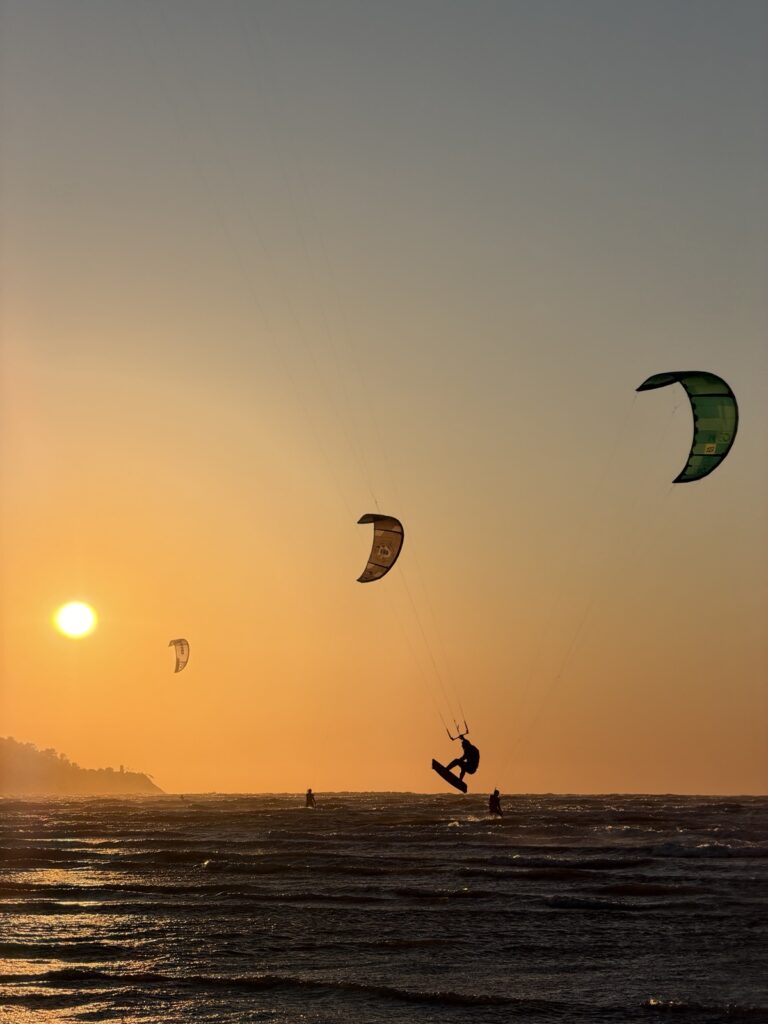
Kitesurfing has a bad reputation it earned twenty years ago and has not deserved for a decade. Modern kites depower properly, modern bars release cleanly, and the accidents that still happen almost never come from equipment failure.
They come from three things: riding in the wrong wind, riding in the wrong place, and not knowing who has priority when two riders meet at speed.
All three are fixable by reading this page and then behaving accordingly.
The ten rules, short version
- Starboard tack has right of way. Right hand forward, you keep your course.
- When passing, the upwind rider raises the kite, the downwind rider drops it.
- Overtaking is your problem. Stay clear of the rider you are passing.
- The rider coming in to the beach has priority over the rider heading out.
- The rider on a wave has priority. Do not drop in.
- Do not jump without clear space downwind. If in doubt, do not jump.
- Everyone who is not kiting has priority over everyone who is.
- Never fly a kite over people, and never walk a kite through a crowd.
- Offshore wind means no kiting, whatever your level.
- Check the forecast, check your gear, tell someone where you are going.
Everything below is the long version.
 .
.
Right of way on the water
Kitesurfing borrows its priority rules from sailing, because the problem is the same: two craft, no brakes, and lines you cannot see from a distance.
Starboard tack has priority
Look at your hands on the bar. Whichever hand is closer to the front of the board is your leading hand.
- Right hand forward means you are on starboard tack. You have priority. Hold your course and speed so the other rider can predict you.
- Left hand forward means you are on port tack. You give way. Change course early and obviously.
“Priority” does not mean “correct”. If the other rider has not seen you, you give way anyway and complain about it on the beach afterwards. Nobody has ever won an argument from a hospital bed.
Passing: kite high, kite low
Two riders crossing on opposite tacks have four lines each in the air between them. The rule keeps those lines apart:
| Your position | What you do |
|---|---|
| Upwind rider (closer to where the wind comes from) | Raise the kite toward 12 o’clock |
| Downwind rider | Keep the kite low, near the edge of the window |
The downwind rider then passes underneath the upwind rider’s lines. Decide early and hold it. The dangerous version is two riders both changing their minds at ten metres.
Overtaking
If you are the faster rider coming from behind, the entire responsibility is yours. Pass with room, and never pass between another rider and the beach unless there is a lot of space.
Coming in beats going out
A rider approaching the beach is committed, slowing down, and about to have their hands full. A rider heading out has options. The one heading out waits.
Waves
The rider already riding a wave has priority over everyone else. Do not drop in on someone. This matters on the Adriatic side of our spot, not on the lagoon.
Jumping
Jumping needs empty space, because you can travel a long way downwind in the air and you cannot steer much while you are up there.
Before you jump, look downwind and upwind. Rough numbers that most schools and beaches use: nothing within about 50 metres downwind of you, and no one close behind you upwind. On a busy beach, ride out to open water first.
Never jump near the shore, near swimmers, or near obstacles.
Everyone else wins
Swimmers, surfers, paddlers, fishermen, boats, dogs and children all have priority over you, always, regardless of who was there first or what the local signage says. Keep a wide margin from the swimming area. At our spot in summer that margin is the reason we ride the lagoon rather than the town beach.
On the beach
The beach is where most injuries actually happen, because that is where the kite is close to hard objects and to people.
- Set up downwind of others, not on top of them, and never with your lines crossing someone else’s.
- Weigh your kite down with sand while you rig. An unattended kite is a loose kite.
- Launch and land at the edge of the window, with an assistant holding the kite by a wingtip, never by the lines.
- Agree the signals before you hand a kite over. Thumbs up means launch, a flat hand tapping the head means land. If you do not know the person, say it out loud.
- Walk with the kite at the edge of the window, low and parked, and never over other people’s heads.
- Land your kite properly rather than dropping it and hoping. A kite lying in the wind with tension in the lines will relaunch itself.
If you cannot find an assistant, self-launching and self-landing are skills your instructor should teach you before you ride alone. They are not skills to improvise on a windy day.
Your safety systems
Every modern setup has two independent ways out.
The quick release on the chicken loop. One firm push and the kite depowers, flying on a single line. Practise this on land until it is boring. Then practise it in the water. Most riders who freeze in an emergency have simply never fired one under load.
The safety leash, which keeps the depowered kite attached to you. It has its own release for the rare case where you need to let the whole kite go, for example if it is tangled in something you cannot swim away from.
Two habits worth having for the rest of your kiting life:
- Check that the quick release is clean and moves freely every single time you rig. Sand is what jams them.
- Reassemble it correctly after you fire it. A release you cannot re-arm is a session over, which is fine. A release you re-arm wrongly is worse than none.
Self-rescue
At some point the wind will drop, or a line will break, or you will end up downwind of everything with no way back. Self-rescue is the skill that makes that a story rather than a rescue.
The sequence, in order:
- Stop and think. You float. The kite floats. Nothing about this is urgent yet, and panic is what turns it into an incident.
- Depower. Fire the quick release so the kite flags out on one line.
- Recover the bar and wind the lines onto it as you pull yourself toward the kite, keeping the lines tidy and away from your body.
- Reach the kite and take hold of it at the leading edge.
- Sail in. With the kite held as a sail, the wind pushes you downwind. Aim for the beach you can actually reach, not the one you came from.
- Pack down if you must. Deflate the leading edge, roll the kite from the tips toward the middle, and swim with it.
Practise this in shallow water with your instructor watching, on a calm day, before you need it. Every one of our courses covers it, and it is the part students later say they were most glad to have.
Weather: the part that actually hurts people
Equipment rarely fails. Weather regularly does.
Offshore wind
Wind blowing from the land out to sea is the single most dangerous condition in kitesurfing. If anything goes wrong, everything that goes wrong takes you further from shore, and the water close to the beach is deceptively calm so it looks inviting.
Do not ride in offshore wind. Not as a beginner, not as an expert, not “just for a bit”, not without a boat.
Read the full breakdown of wind directions on the wind page.
Gusts and squalls
A gust that doubles the wind speed doubles nothing: kite power rises with the square of wind speed, so a jump from 15 to 25 knots is close to three times the pull. That is what lofts people.
Watch for dark lines on the water, towering clouds building inland, and a sudden drop in temperature. If a front is coming, land before it arrives, not while it arrives.
Thunderstorms
Get off the water and away from the kite. There is no version of this worth discussing.
Cold
Cold hands lose grip and cold bodies lose judgement long before they feel cold. Dress for the water temperature and the wind chill, not the air temperature. Month by month guidance is on the equipment page.
Personal protection
- Helmet. Your own board is the most likely thing to hit you. Wear one while you are learning, and keep wearing it.
- Impact vest. Softens board impacts, adds a little flotation, and adds warmth. Standard kit in your first season.
- Hook knife. A small blade on your harness for cutting a line you are caught in. You will probably never use it. Carry it anyway.
- Sunscreen and water. Heat exhaustion ends more sessions on the Albanian coast in August than the wind does.
Before every session: the check
The forecast
- Wind strength now and in three hours, and the direction relative to the beach
- Any front, storm or squall in the window you plan to ride
- Tide and current if the spot has them
The spot
- What is downwind of you? Assume you will end up there.
- Where can you land safely if you have to come in early?
- Who else is on the water, and where are the swimmers?
The gear
- Lines untangled, no knots, connected to the right pigtails
- Bridles free, not looped over a wingtip
- Quick release clean, moving freely, correctly assembled
- Leash attached to you, and to the correct point
- Kite pressure right, no slow leaks
You
- Someone knows where you are and when you plan to be back
- You are not riding alone at an empty spot
- Your kite size matches the wind, not your ego
FAQ
Who has right of way in kitesurfing? The rider on starboard tack, meaning right hand forward. The rider on port tack gives way. Beyond that, riders coming in beat riders going out, and everyone who is not kiting beats everyone who is.
What does kite high, kite low mean? When two riders pass, the one further upwind lifts the kite toward 12 o’clock and the one further downwind keeps it low. The downwind rider then passes under the upwind rider’s lines.
How far from swimmers should I stay? As far as the beach rules require, and further if you can. Fifty metres is a common minimum. At crowded beaches, ride somewhere else.
Is it safe to kitesurf alone? No. Even competent riders should have someone on the beach who will notice they have not come back.
What is the most dangerous mistake beginners make? Riding in offshore wind because the water near the beach looked calm.
Do I need insurance? Yes, and check that it covers kitesurfing specifically. Any damage or loss of rental equipment is the rider’s responsibility.
Learn the rules on the water, not from a page
Every one of our courses covers safety systems, self-rescue and right of way before you ever get on the board.