Kitesurfing Equipment: What You Ride, What You Rent, What You Need
Kitesurfing runs on five things: a kite, a bar, a board, a harness, and the safety gear that keeps all of it under control. Everything else is refinement.
This page explains each part, what actually matters when you choose it, and what we fly and rent at our school in Durrës. If you’re taking lessons, you don’t need to own any of it: every lesson includes the full kit.
The complete kit at a glance

| Part | What it does | Included in lessons | Available to rent |
|---|---|---|---|
| Kite | Your engine, turns wind into pull | ✅ | ✅ |
| Bar and lines | Steering, power control, safety release | ✅ | ✅ |
| Board | What you ride on | ✅ | ✅ |
| Harness | Transfers the pull from your arms to your hips | ✅ | ✅ |
| Safety leash | Connects you to the kite after a release | ✅ | ✅ |
| Impact vest / helmet | Protection while learning | ✅ | ✅ |
| Pump | Inflates the kite | ✅ | ✅ |
| Wetsuit | Warmth outside high summer | ✅ | ✅ full range of sizes and thicknesses |
Kites
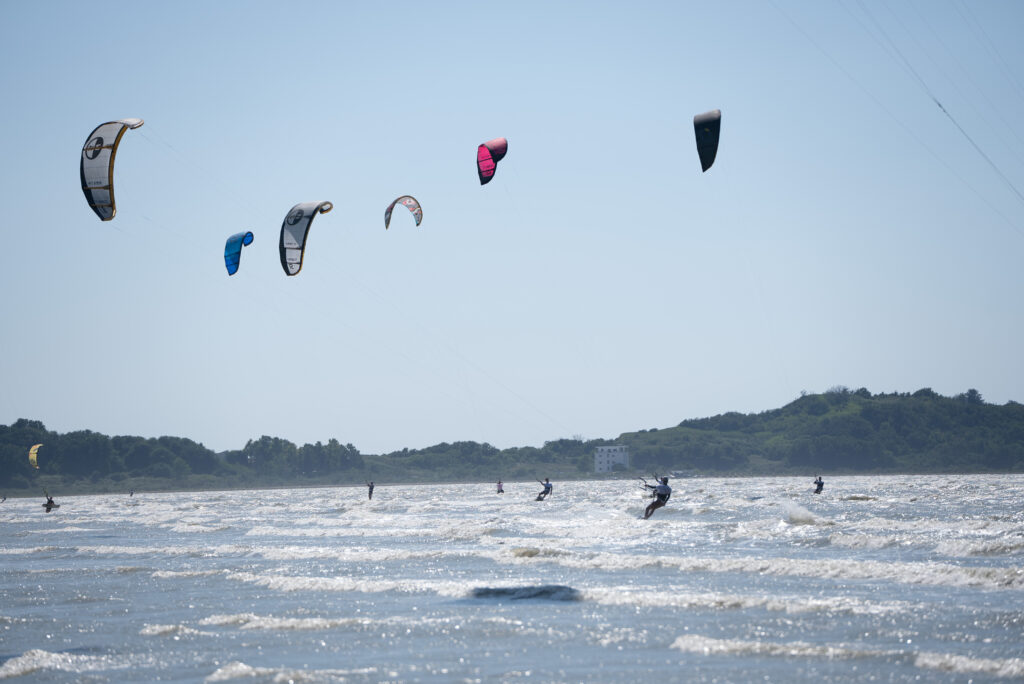
The kite is the engine. Size, shape and construction decide how much pull you get, how fast it turns, and how forgiving it is when you make a mistake.
Tube kites (LEI) vs foil kites
Tube kites, also called LEI or “leading edge inflatable”, have an inflatable front tube and struts. They hold their shape, relaunch off the water easily, and are what almost every school teaches on. If you’re learning, you’re learning on a tube kite.
Foil kites have no inflatable parts. Air enters through openings on the leading edge and inflates internal cells, like a paraglider. They fly in less wind, pack down smaller, and are the better choice for light-wind days and hydrofoiling, but water relaunch is less forgiving, so they’re not a beginner’s first kite.
| Tube kite (LEI) | Foil kite | |
|---|---|---|
| Water relaunch | Easy | Demands technique |
| Low-wind performance | Moderate | Excellent |
| Packing size | Bulky | Very small |
| Best for | Learning, waves, big air, all-round | Light wind, foiling, travel |
| Durability on shore | Robust | Needs care with sand |
Kite types by riding style
- Freeride: the all-rounder. Stable, easy depower, forgiving. What most riders own and what most of our rental fleet is.
- Freestyle / big air: more grunt, more lift, faster turning. For unhooked tricks and boosting.
- Wave / strapless: drifts downwind with you while you ride a wave so the lines stay tight. This is what you want on the Adriatic side of our spot.
- Light wind: big sizes and high aspect shapes that get going in 10–12 knots.
- Foil kites for hydrofoiling: small, efficient, and enough for a foil board in very little wind.
Which kite size do I need?
Kite size depends on two things: how much you weigh and how hard the wind blows.
Size down as the wind builds.
| Rider weight | 12–15 knots | 15–20 knots | 20–25 knots | 25+ knots |
|---|---|---|---|---|
| 50–65 kg | 11–12 m² | 9–10 m² | 7–8 m² | 5–6 m² |
| 65–80 kg | 12–14 m² | 10–12 m² | 8–9 m² | 6–7 m² |
| 80–95 kg | 15–17 m² | 12–14 m² | 9–10 m² | 7–8 m² |
| 95+ kg | 17–19 m² | 14–15 m² | 11–12 m² | 8–9 m² |
Treat this as a starting point, not a rule. Board size, riding style and how flat the water is all shift it. On a rental day, tell us your weight and we’ll hand you the right kite for the forecast. That is the whole point of renting on
the spot instead of hauling your own quiver through an airport.
What kites are made of
- Dacron: the stiff polyester used in the leading edge and struts on most tube kites. Proven, cheap to repair, heavier.
- Aluula: a composite that replaces Dacron on high-end kites. Much lighter and much stiffer for the same strength, which means better low-end drift, sharper steering, and a kite that holds its shape in gusts. It also costs
significantly more. - Ripstop canopy: the sail itself, usually a coated polyester in the 30–75 g/m² range depending on where it sits on the kite.
Brands you’ll see on the water
Duotone · Flysurfer · North · Core · Cabrinha · Naish · Ozone · F-One ·
Slingshot · Eleveight · Reedin · Airush
No brand is “the best”. They trade off differently between low-end power, turning speed, bar pressure and price. What matters far more when you’re learning is that the kite is the right size and in good condition.
Bar and lines

The bar is where you steer and where every safety decision happens. Know it before you know anything else about your gear.
Parts of the bar
- Bar: pull one side, the kite turns that way. That’s the steering.
- Depower strap or cleat: trims the kite’s angle of attack, so how much
power it makes at all. - Chicken loop: the loop that hooks into your harness.
- Quick release: one push and the kite is depowered. This is the single
most important part of your equipment. - Safety leash: keeps the kite attached to you after the release so it
can’t fly off down the beach. - Lines: usually four (two front, two steering), sometimes five.
Line length
Standard bars run 20–24 m lines. Shorter lines turn the kite faster and give a smaller wind window; longer lines make more power and take longer to react.
We teach on shorter lines so the kite is slower, more predictable and easier for the instructor to talk you through. You move to full-length lines once you’re steering confidently.
Safety first, every session
Check the quick release before every session. Pull it. It should fire under load, and you should be able to re-assemble it without thinking. Every one of our lessons starts here.
Boards

Twintip
Symmetrical, rides in both directions, no need to turn it around when you change tack. Every beginner starts here and most riders never leave. Bigger boards plane earlier and are more forgiving in light wind; smaller boards are livelier and better in strong wind.
| Rider weight | Typical twintip size |
|---|---|
| Under 60 kg | 130–136 × 38–40 cm |
| 60–75 kg | 135–140 × 40–42 cm |
| 75–90 kg | 138–145 × 42–44 cm |
| Over 90 kg | 142–150 × 44–46 cm |
Learning? Go bigger than the chart. A large board gets you up and riding in less wind, and that’s the whole game in your first ten hours.
Directional and strapless boards
A surfboard shape, ridden in one direction like a surfboard. Strapless riding on the wave side of our spot is one of the most rewarding things you can do on the Albanian coast, and it’s a completely different sport from twintip freeride.
Foilboards
Short, thick, and built to take the load of a hydrofoil mast. See hydrofoils below.
Light wind boards
Extra volume and surface area to plane in 10–12 knots. On a thermal summer day that fills in slowly, a light wind board buys you an extra hour on the water.
Pads, straps and boots
- Pads and straps: the standard. You can pull your feet out instantly,
which is exactly what you want while learning. - Boots: locked in, more control, more direct pop for freestyle. Also more
strain on your knees and no quick escape. Not for beginners.
Hydrofoils

A hydrofoil lifts the board clear of the water on a wing below the surface. It rides in wind that leaves everyone else on the beach, it’s near-silent, and it turns a marginal forecast into a session.
Parts of a foil
- Front wing: generates the lift. Bigger = earlier take-off and slower
flight; smaller = faster and more demanding. - Stabiliser (rear wing): the pitch stability.
- Fuselage: connects the wings, sets how the foil pitches.
- Mast: the vertical part. Longer masts (85–100 cm) ride better in chop;
shorter masts (60–75 cm) are more forgiving to learn on. - Baseplate: the mount into the board.
Aluminium vs carbon
Aluminium is heavier, cheaper and takes a beating, the right choice for learning and for rental. Carbon is lighter, stiffer and more responsive, and it does not enjoy meeting the sand.
Why the lagoon is ideal for foiling
Learning to foil means a lot of falling, and falling onto a foil in deep water is how people get hurt. Waist-deep calm water where you can stand up, and where your instructor can walk over to you, is about the best place there is to start
foiling.
Harnesses

The harness takes the kite’s pull off your arms and puts it on your hips. Without it you’d last about four minutes.
Waist vs seat
Waist harness: sits around your waist. More freedom of movement, better for freestyle and anything unhooked, and the standard for most riders. It can ride up if you’re not yet leaning back properly against the kite.
Seat harness: has leg straps and sits lower on your hips. It cannot ride up, which is why many beginners find it more comfortable, and why it suits riders with back problems.
Soft vs hardshell
Soft harness: flexible, forgiving, molds to your body. Comfortable straight out of the bag and easy to size for different people, which is why school and rental harnesses are usually soft.
Hardshell harness: a rigid outer shell that spreads the load across your whole back instead of squeezing you. Far more support once it’s on correctly and it doesn’t rotate, but it needs to fit your body to work.
Spreader bar
The metal bar across the front of the harness:
- Hook: the classic. The chicken loop hooks straight in.
- Rope slider: a rope instead of a hook, letting the connection slide
across as you rotate. The freestyle standard for unhooked riding.
Getting the fit right
A harness that’s too loose rides up your ribs; too tight and you can’t breathe
on a long run. It should sit snug on your hips with no vertical movement when
someone pulls the loop. We’ll fit you at the spot before you go out.
Safety gear

- Helmet: cheap protection against your own board and other people’s equipment. Mandatory on all our beginner lessons.
- Impact vest: softens board hits and adds a little flotation. Worth it every session in your first season.
- Safety leash: connects you to the kite after you fire the quick release. Check the attachment point every time you rig up.
- Hook knife: a small blade on your harness to cut a line you’re tangled in. You will almost certainly never use it. Carry it anyway.
- Buoyancy aid: if you’re not a confident swimmer, tell us before your first lesson. In waist-deep water it matters less than anywhere else, but we want to know.
Wetsuits and neoprene: what to bring, month by month

This is the question every visiting rider asks before booking a flight:
do I need a wetsuit in Albania, and how thick?
Short answer: from June to September you probably don’t. Boardshorts and a lycra top are enough. May and October call for a 3/2 mm. From November to April the Adriatic drops to 14–19 °C, and neoprene decides whether you ride for one hour or four.
What to pack, by month
All figures below are long-term monthly averages for the Durrës coast. The air column is the average daily high, not the hottest it gets. See the note under the table.
| Month | Sea, avg | Air, avg high | Air, typical night low | What to bring |
|---|---|---|---|---|
| January | 15 °C | 13 °C | 4 °C | 5/4 mm steamer, boots, gloves, hood on the coldest days |
| February | 14 °C | 15 °C | 6 °C | 5/4 mm steamer, boots, gloves. Coldest water of the year |
| March | 14 °C | 18 °C | 8 °C | 5/4 mm steamer + boots; 4/3 mm late in the month |
| April | 16 °C | 21 °C | 11 °C | 4/3 mm full suit, boots useful |
| May | 18 °C | 25 °C | 14 °C | 3/2 mm full suit |
| June | 22 °C | 30 °C | 18 °C | Shorty, or 3/2 mm for long sessions |
| July | 25 °C | 33 °C | 21 °C | Boardshorts and a lycra top |
| August | 26 °C | 34 °C | 21 °C | Boardshorts and a lycra top. Warmest water of the year |
| September | 24 °C | 29 °C | 18 °C | Boardshorts; shorty if you’re out for hours |
| October | 21 °C | 24 °C | 14 °C | Shorty or 3/2 mm full suit |
| November | 19 °C | 20 °C | 10 °C | 3/2 mm, 4/3 mm from mid-month |
| December | 16 °C | 15 °C | 6 °C | 4/3 mm full suit + boots, 5/4 mm on cold days |
Averages, not maximums. A 34 °C August average high means plenty of days
well above it: high summer regularly pushes past 38 °C, and in August 2025
Durrës recorded 42.4 °C, an all-time August record for Albania. On days like
that the sea breeze is the only comfortable place to be, which is exactly why
the thermal wind exists. Sea temperatures move far less: the monthly average
is within a degree or two of what you’ll actually feel.
Treat the table as a packing guide, not a forecast. A windy April afternoon
feels several degrees colder than 16 °C suggests, and the wind chill of a
25-knot day isn’t in any table. Message us for the actual water temperature
the week you arrive.
Reading the table for a trip: the water is at its coldest in February and
peaks in August, but it lags the air by about two months. That is why September
and October still feel warm while May, with the same air temperature, does not.
If you want to kite in nothing but boardshorts, come between June and September.
Kitesurfing is colder than swimming: size your neoprene for wind, not water
Swimmers are submerged and still. You’re out of the water, moving at speed, wet,
in 20 knots of wind. Evaporation off a wet suit in that wind pulls heat out of
you fast, which is why kiters routinely wear one step thicker than a
snorkeller would in the same sea.
Two things that matter more than the millimetres:
- A windproof chest panel. Smoothskin or thermal-lined neoprene across the
chest and back blocks wind chill where the harness pins the suit against you. - A suit that actually seals. A cheap 5/4 that flushes cold water down the
neck every crash is worse than a good 4/3.
Reading the numbers
“4/3 mm” means 4 mm neoprene on the torso and 3 mm on the arms and legs:
warmth where your core is, flexibility where you move. The same logic gives you
5/4, 3/2, and so on.
| Style | What it is | When |
|---|---|---|
| Rash vest / lycra | Thin top, no warmth, blocks UV | High summer |
| Shorty / spring suit | Short arms and legs, 2 mm | ~22–24 °C water |
| Full suit (steamer) | Full arms and legs | Below ~22 °C water |
| Long john / farmer john | Sleeveless full-length | Rare in kiting |
Zips and seams
- Chest zip: the kitesurfing standard. Least flushing, and the harness
doesn’t sit on a zip. - Back zip: easier to get into, flushes more water on impact.
- Zip-free: the warmest and most flexible, the hardest to put on.
- Flatlock seams: cheap, stitched through, they leak. Summer suits only.
- GBS (glued and blind-stitched): the standard for 3/2 and up.
- Liquid-taped seams: sealed on the outside, warmest, most expensive.
Boots, gloves and hoods
- Boots: 3 mm from around 16 °C water, 5 mm below 14 °C. They also protect
your feet on rough entries. Note that boots change how a twintip’s footstraps
fit, so bring them if you plan to use your own board. - Gloves: 3 mm below about 14 °C. They cost you bar feel; most riders
accept that in December. - Hood: you lose a lot of heat through your head, and a crash pushes cold
water straight into your ears. Worth it on the coldest winter days.
Sun is the other half of the problem
From June to September the sun does more damage than the cold. Reflection off the water hits you twice.
- Long-sleeve UV lycra, cooler than sunscreen and it doesn’t wash off
- Reef-safe sunscreen, reapplied on face, ears, back of the neck, tops of the
feet - Sunglasses with a strap, and a hat for the beach
- Drink more water than you think you need, because thermal wind days are hot days
Looking after neoprene
Rinse in fresh water after every session, dry inside out in the shade, never in direct sun, and never in a washing machine. Sand in the zip ends a suit faster than years of riding do.
You don’t have to bring any of it
We keep the full range of neoprene at the school: lycra and rash vests for the summer sun, shorties for the shoulder months, full 3/2 and 4/3 suits, winter steamers, plus boots, gloves and hoods for the cold season. Whatever the water
is doing the week you arrive, we have the suit for it.
Sizes and availability change through the season, so tell us your dates and your size and we’ll confirm what’s ready for you.
Ask us what neoprene to bring →
Pumps and accessories
- Pump: a kite-specific pump with a pressure gauge and the right adapters.
Never inflate a kite with a compressor. - Repair kit: bladder patches, ripstop tape, spare pigtails, spare line.
- Kite bag / travel bag: a compression bag for one kite, a board bag for
flying. - Gear leash / stake: a sand stake or a weighted bag stops your kite
wandering off while it’s parked on the beach.
Our fleet
Everything below is available to you wherever we are in Albania. Lessons include the full beginner setup; independent riders can rent the same gear by the hour, day or week.
What we teach on
| Gear | What we use | Why |
|---|---|---|
| Teaching kite | Flysurfer Indie | Stable, forgiving and predictable. A kite that makes learning easier instead of exciting |
| Bar | Short school lines | Slower, more predictable kite while you learn to steer |
| Board | Large beginner twintips from Flysurfer | Planes early so you get riding in less wind. |
| Harness | Soft harnesses, full size range | Comfortable from the first hour, fits every body. |
| Safety | Helmet and impact vest for every student | Included, not extra |
What we rent
| Category | What we stock | Notes |
|---|---|---|
| Flagship tube kite | Duotone with Aluula construction | The light, stiff, high-end option. |
| Big Air tube kite | Flysurfer Era | Big-Air specialist, packs small, superb on marginal thermal or storm days |
| Foil kites | Flysurfer foil kites | For light wind and foiling up to 17M |
| Hydrofoil | Complete foil setups | Board, mast, wings. |
| Twintips | Flysurfer, Duotone Jamie SLS | |
| Harnesses | Soft and hardshell, waist and seat | From XS to XL |
| Neoprene | Lycra, shorties, 3/2, 4/3, winter steamers, boots, gloves, hoods | Full size range, ask for your dates |
| Safety gear | Helmets, impact vests, leashes | Included with every rental |
| Single items | Kite & bar, harness & leash, board only, foil board only | From 15 € |
Rental prices:
39 € for 2 hours or a half-day ·
59 € for a full day ·
159 € for 3 days ·
85 € for a supervised day with an instructor.
Ask what’s in stock for your dates →
Buying your first kit
What to buy first, in order
- Harness: the one piece that must fit you. Buy it before anything else,
and buy it after you’ve tried a few. - Kite and bar: one kite in the size that covers your most common local
wind, matched with its own bar. - Board: bigger than you think, with pads and straps.
- Safety gear: helmet, impact vest, hook knife.
- Pump, repair kit, bags: the boring purchases that save sessions.
New or second hand?
A used kite two or three seasons old at half price is a good first kite, as long as you check: canopy for tears and thin patches, leading edge for slow leaks, bladders for old repairs, and the bar for line wear and a quick release that
actually fires. Buy the bar and kite together, because mixing brands is possible but it’s not a beginner’s project.
Try before you commit
The cheapest way to find out what you like is to ride several kites before youown one. That’s what a rental fleet is for. Ride the Indie, ride the Era, ride the Duotone, then spend your money knowing what you want.
Flying with kite gear
A board bag with two kites, a board and a harness typically lands between 15 and 23 kg, which most airlines charge as one piece of sports equipment or excess baggage. Weigh it before you leave. Or rent here and travel with hand luggage only.
FAQ
Do I need my own equipment for a lesson?
No. Every lesson includes the kite, bar, board, harness, helmet and impact vest.
Bring swimwear and sunscreen.
What equipment do beginners learn on?
Flysurfer Indie kites on short lines, a large twintip, and a soft harness: the combination that makes the first hours as easy as possible.
Can I rent gear without taking a lesson?
Yes, if you’re an independent rider. If you’re nearly there but not quite, book a supervised rental day: full gear plus an instructor keeping an eye on you,
85 € per person.
What kite size should I rent?
Tell us your weight and we’ll match the kite to the day’s forecast. That’s the
advantage of renting at the spot.
Do I need to bring a wetsuit to Albania?
Only if you want your own. We keep the full range at the school:
lycra and rash vests through to winter steamers with boots, gloves and hoods. In July and
August you won’t need neoprene at all; from October to April you will. Tell us your dates and size and we’ll have it ready.
Do you have foil equipment?
Yes. Flysurfer foil kites and complete hydrofoil setups. The shallow lagoon is an unusually good place to learn to foil, though you have to go a bit deeper to avoid hitting the sea bottom.
Is my equipment insured?
No. Any damage or loss of rental equipment must be covered by the rider’s own insurance.
Can I leave my gear at the spot?
Of course its super safe
Learn on our gear before you buy your own
Three hours, semi-private, all equipment included: 105 €.